ai.google website redesign, discovery, usability • 2024
Redesigning the ai.google website for tech-forward AI consumers and influencers
Overview: Ahead of Google I/O in 2024, my team worked with Google AI to redesign their website. Working closely with a strategist, producer, and two designers, I led two rounds of research - the first focused on discovery and audience definition, and the second on usability and function.
My responsibilities: I led all research efforts including research design, recruiting a niche audience, synthesizing results into actionable insights, and sharing them directly with our key stakeholder at Google.
My team: 1 Researcher (me), 1 Strategist, 2 Designers, 1 Producer
The text-heavy, repository-style site failed to tell a cohesive story, showcase proof points, and illustrate Google’s commitment to responsibility.
KEY PROBLEM
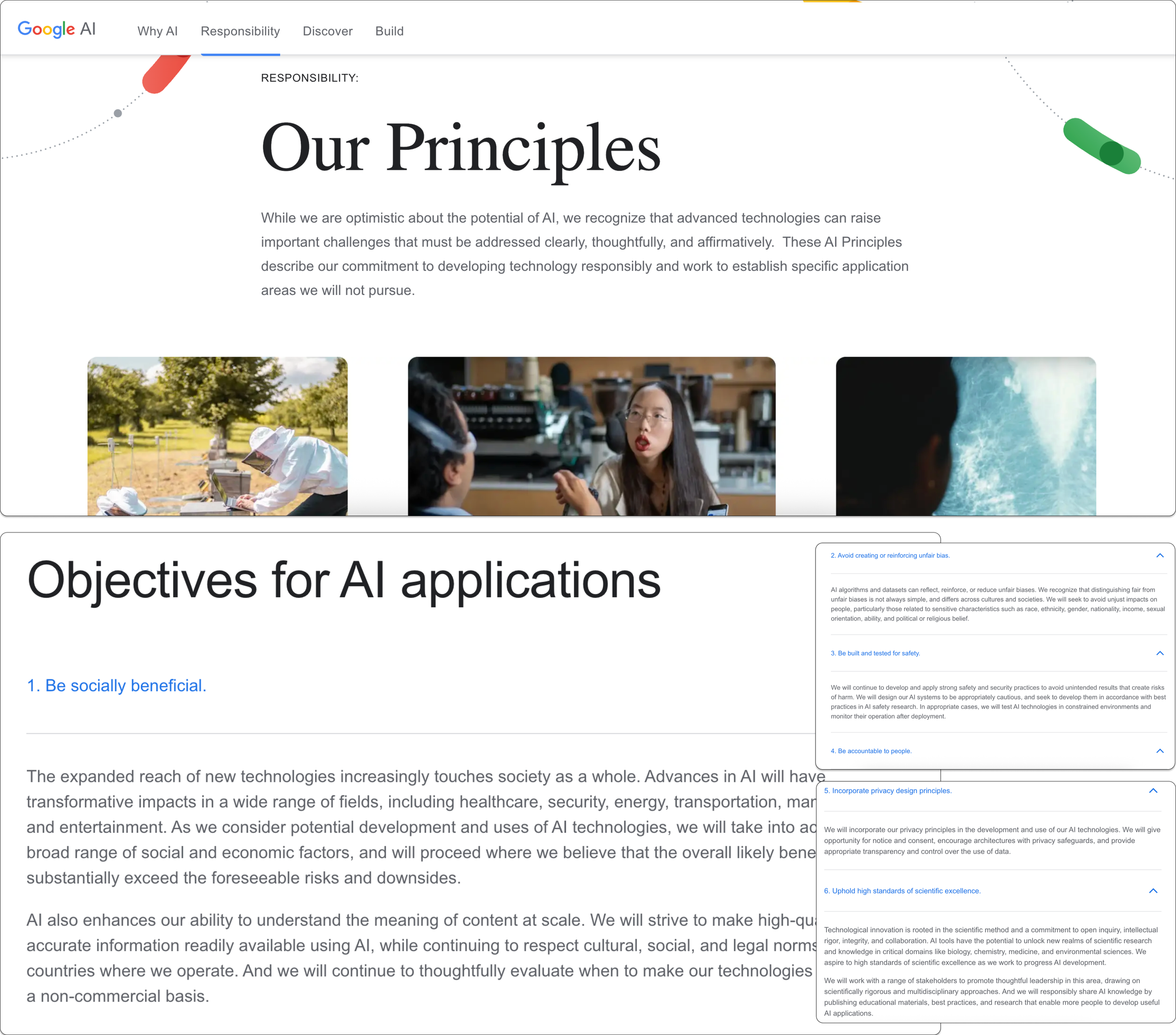
Despite Google’s history and deep experience and expertise in AI the existing ai.google site failed to excite users about products, and instill trust and confidence in their approach.
It was thorough, highlighted dense principles & objectives and dove into the details of AI responsibility rather than allowing consumers to understand relevant applications.
Through conversations with stakeholders and other teams at Google, we determined that we needed to design a site that would differentiate Google from its competitors and:
Tell Google’s story as a legacy AI leader
Excite consumers about AI products
Build trust around AI safety & responsibility
In support of these goals, I led two rounds of research: discovery and usability
PROCESS
Through primary user research with our core audiences, I needed to:
Understand audience perceptions of the AI landscape, including current and historical leaders in the industry
Evaluate attitudes around AI responsibility and safety
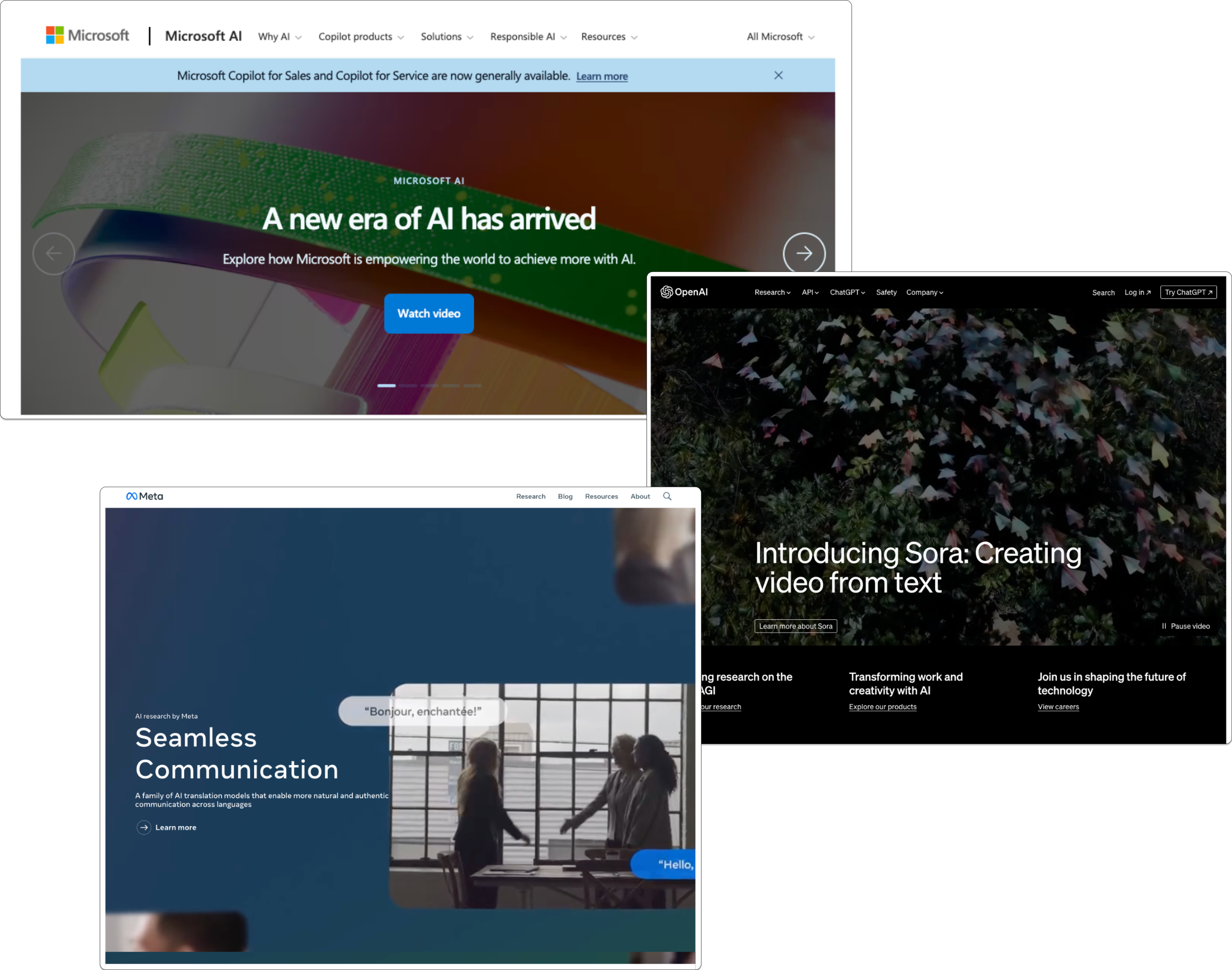
Evaluate how participants respond to existing Google and competitor websites (Microsoft, OpenAI, Meta)
Once designed, test usability of the updated website
Laying strategic foundations
I conducted 10, 60 minute in-depth interviews via Lookback.io with tech-forward consumers and influencers. Sessions covered AI perceptions, reactions to 3 competitor website (Microsoft, OpenAI, MetaAI), and impressions of ai.google.
Recruitment Note: We initially targeted tech influencers who publish content to auxdiences of 10K+, but found them very challenging to recruit in a tight timeline. Rather, we spoke with proxy influencers, and scoped more time to recruit “true” influencers for phase 2.
PHASE 1: DISCOVERY
Insights & Recommendations
PHASE 1 DELIVERABLES
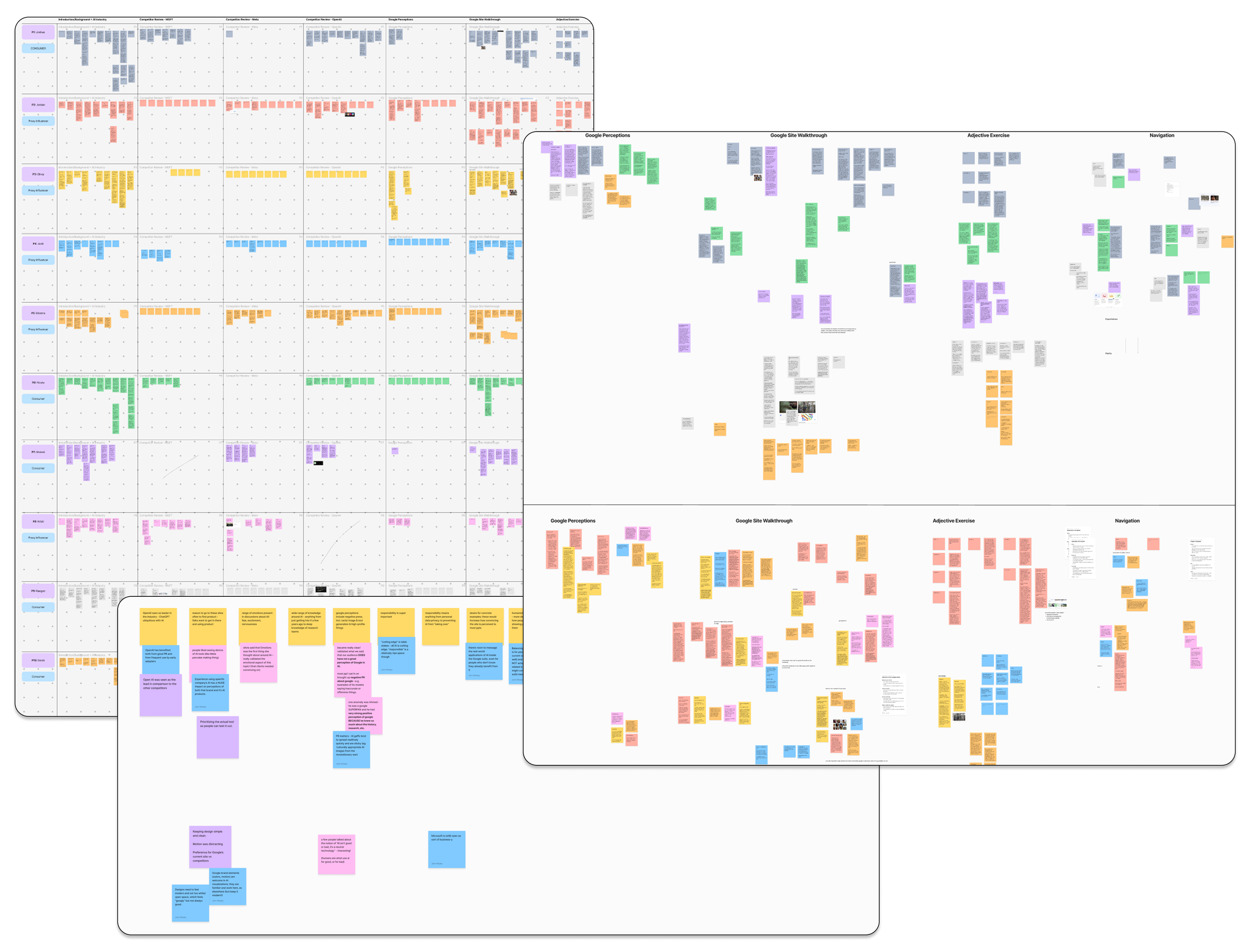
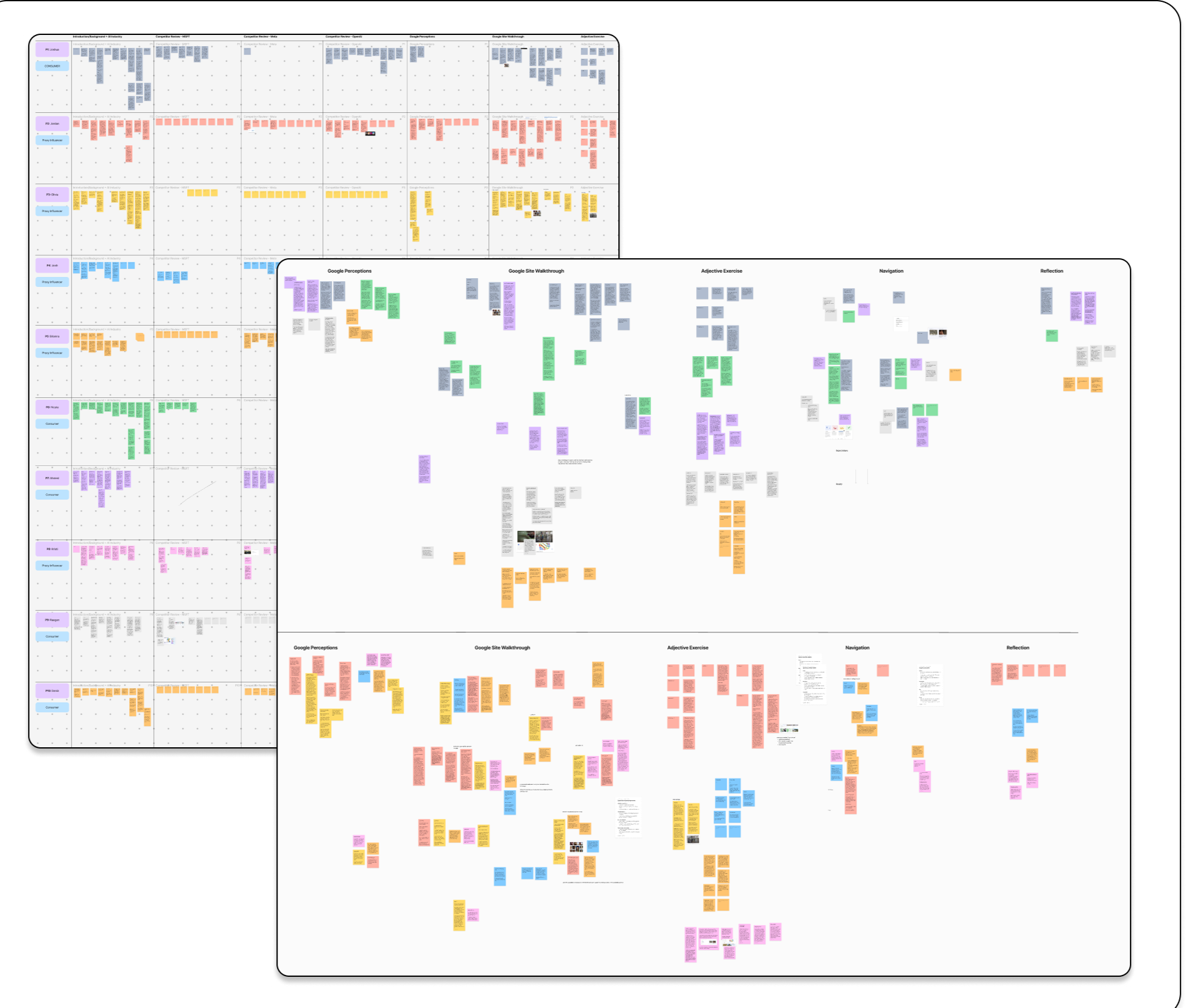
Following data collection, I ran a collaborative team workshop to begin to co-create themes with teammates who observed sessions. Together, we began to ideate on key insights and tie them to design recommendations.
WORKSHOPPING & SYNTHESIS
REPORTING & PRESENTATION
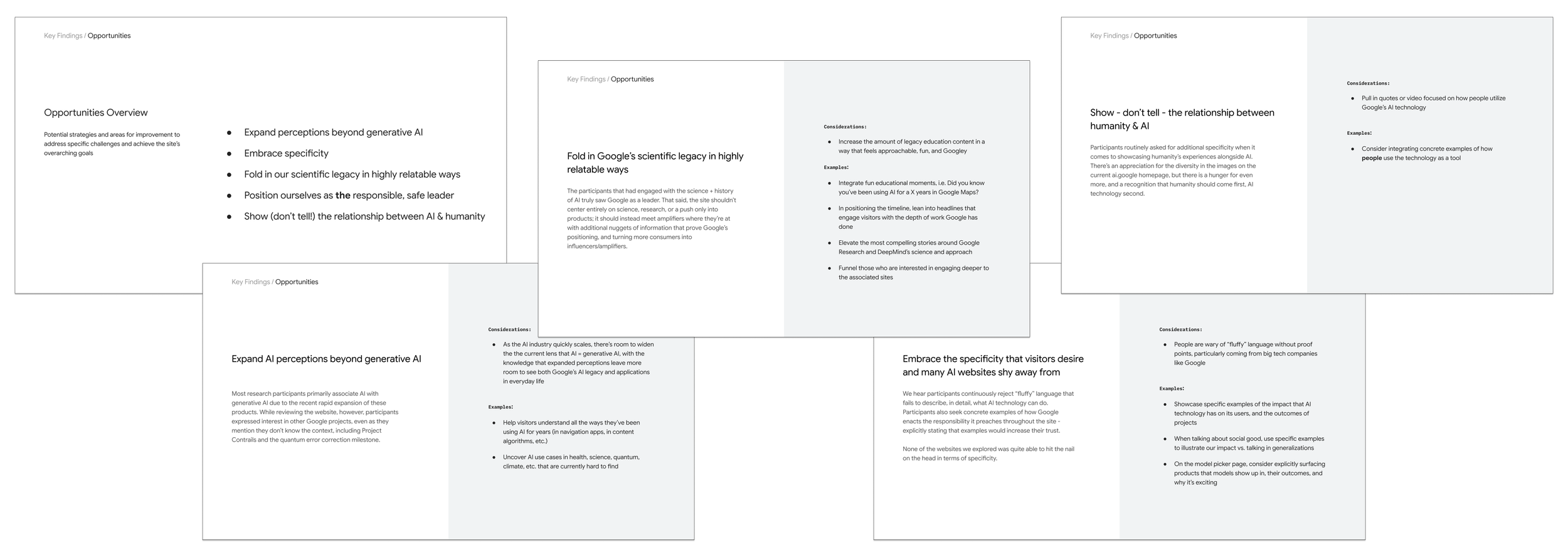
After the workshop, I dove deeper into synthesis and ultimately created and presented a report that outlined audience themes, key needs and pain points around audience needs for the website, and design recommendations.
DESIGN RECOMMENDATIONS
Though the report went into more depth, the key opportunities for design can be summarized into 5 simple recommendations:
Work to expand understanding of AI beyond LLM applications
Embrace specificity
Fold in scientific legacy in highly relatable ways
Position Google as the responsible, safe leader
Show (don’t tell!) the relationship between AI & humanity
The design team ran with these recommendations and strategic foundations to redesign the information architecture and key pages, ahead of the second phase of testing.
ADDITIONAL FINDINGS OF NOTE (click to expand)
-
AI = generative AI. For our audience, AI is synonymous with generative AI despite pre-LLM technology. (Rare) highly technical influencers are outliers.
OpenAI is the leader. They dominate public mindshare; participants see Google as cautious & late to the game despite historical contributions.
Hopeful but skeptical. Though users see AI as helpful, they need proof of responsibility and see the landscape as lacking in this area.
-
Specificity. Participants emphasize desire to see & interact with tools and products to garner excitement.
Relatability. Participants look for examples that relate to their lives and desired use cases.
Innovation and responsibility. Across the industry, companies have room to better communicate how they’re pursuing safety and responsibility.
PHASE 2: USABILITY
Validating Designs and Assumptions
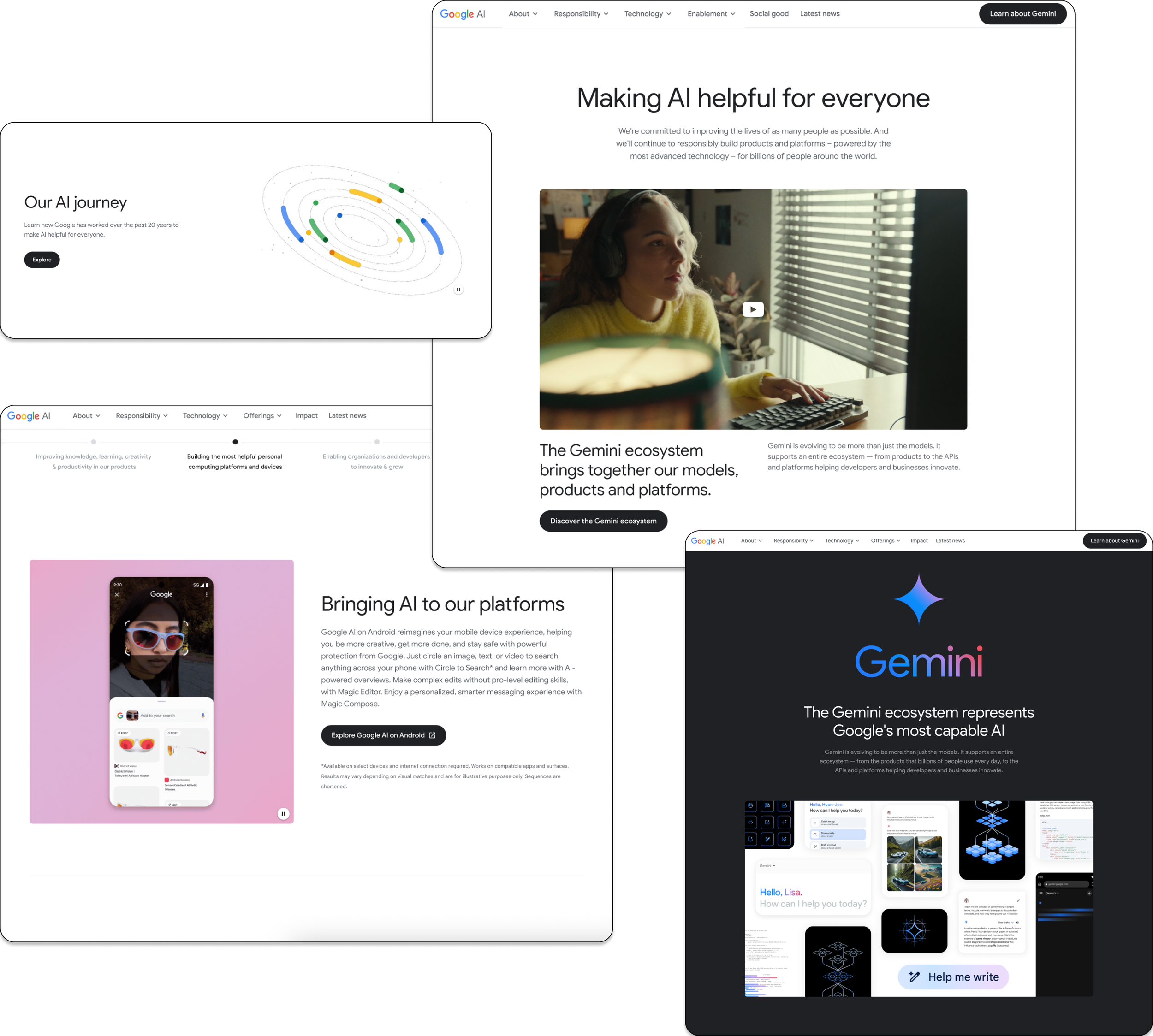
After a few weeks of design iteration rolling in the strategic principles from discovery research, I returned to the project and conducted 10 additional 60 minute in-depth interviews.
These sessions focused on reviewing clickable Figma prototypes of the redesigned ai.google site. Pages included:
Redesigned homepage
“Meet the Models”
Gemini Ecosystem
Navigation
In interviews, I focused on comprehension and resonance of the content across the pages including visual design, written content, and storytelling.
AUDIENCE ADJUSTMENTS
In Phase 2, we validated audience findings from “proxy influencers” with “true influencers"
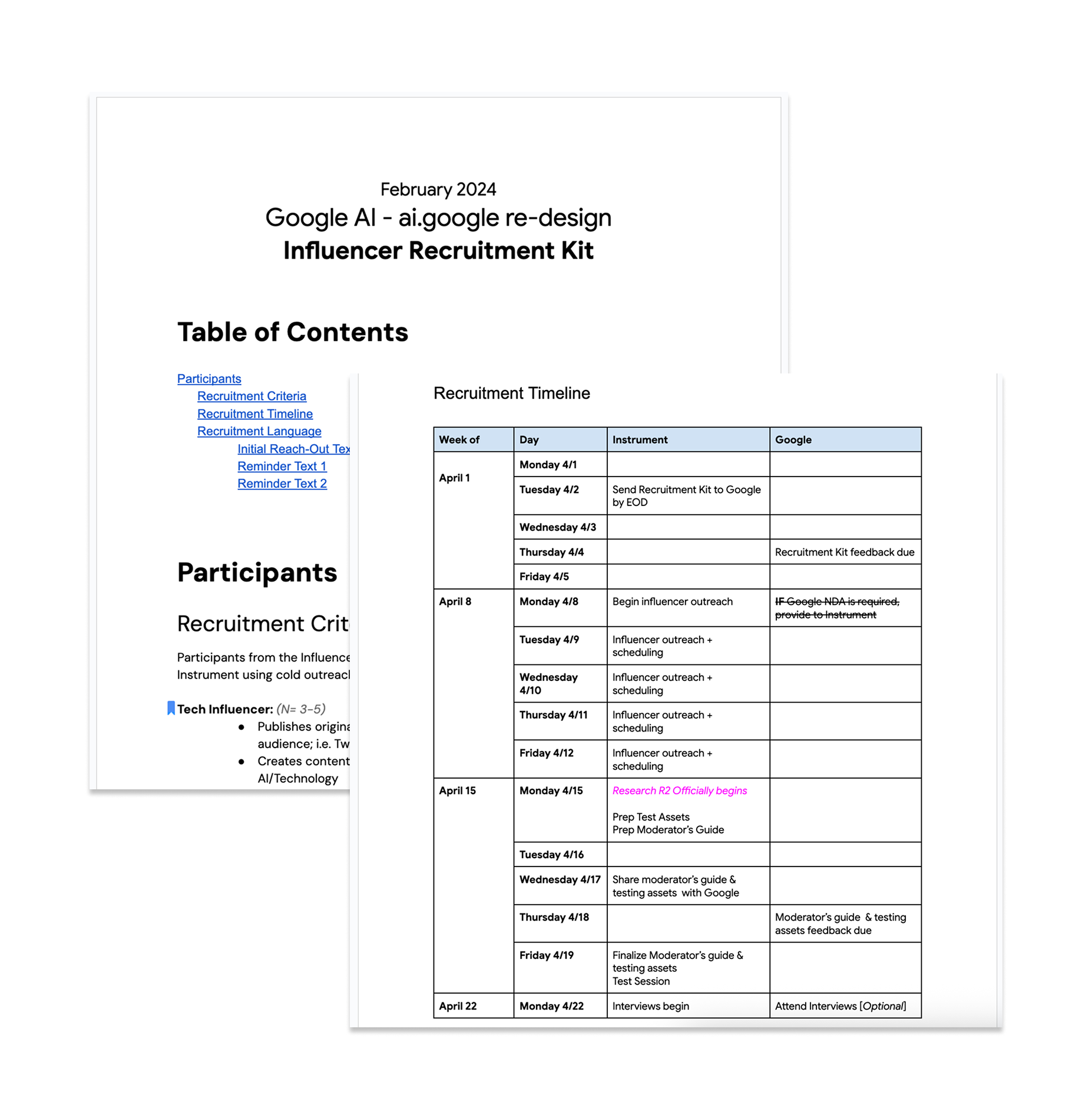
As we had trouble recruiting influencers with audiences of above 10K followers in phase 1, I spent the break between research phases creating a recruitment toolkit, hand-sourcing, and using email to personally reach out and recruit members of the audience.
Ultimately, we found that website needs were consistent across what we’d uncovered with the proxy group, though uncovered additional learnings about how influencers learn and talk about new AI tools as they come to market.
PHASE 2 DELIVERABLES
Tactical Design Recommendations
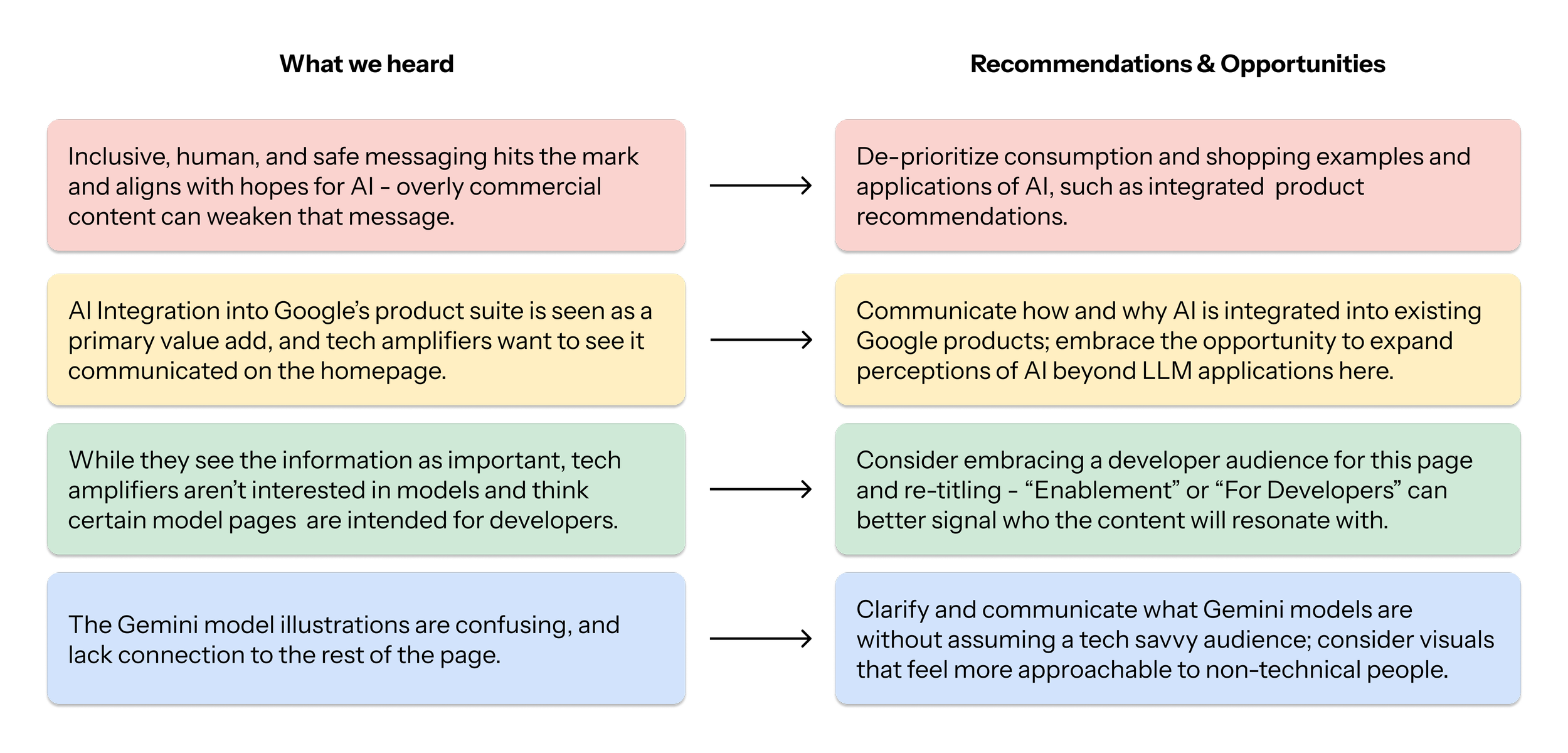
After an additional round of workshopping and synthesis, I created a report that outlined findings mapped to specific design recommendations for each of the pages and features that we tested.
PROJECT IMPACTS
The 2 research sprints informed the project at both the strategic and tactical UX levels
Taken together, the two sprints informed the design of ai.google, particularly by
Understanding the key audiences needs, mental models, and
Simplifying and humanizing overly technical parts of the website
Shifting tone from corporate to human
Elevating key responsibility & safety initiatives in more engaging ways
Beyond the specific and tactical improvements, this work built client confidence in our team. They deeply appreciated our persistence in reaching a specific, niche influencer audience in Phase 2, and were impressed by how well our proxy group represented the attitudes and perceptions held by the true target users.
REFLECTIONS
A key challenge in this research was recruiting influencers with large public audiences in Phase 1. Pivoting to speak with “proxy influencers” - people with smaller but meaningful audiences, either within companies or on LinkedIn - allowed us to gather early insights that quickly informed design. While the team iterated on prototypes, I was able to recruit higher-impact influencers to validate those initial findings, ensuring our insights held true for the broader audience.
This experience reinforced the importance of flexibility in recruitment and the value of validating early insights with the most representative participants whenever possible.